Bio is coming soon...

Get in touch
If you're looking to secure your next role or make your next best hire, we'd love to help. Get in touch to speak with one of our consultants today

Latest insights
Events

What Happens When AI Actually Works? Lessons From Ai4 2026
The conversation around artificial intelligence is changing. At this year’s Ai4 conference in Las Vegas, more than 12,000 attendees gathered to discuss the technologies, strategies and challenges shaping the next stage of AI adoption. For Harvey Nash Tech Evangelist David Savage, the most interesting conversations were not necessarily about getting AI into the enterprise. They were about what comes next. From August 4–6, David moderated a panel exploring the growing role of AI coding assistants and how AI agents could augment software development. He also recorded conversations with digital and technology leaders for Harvey Nash’s Tech Talks podcast. Across those discussions, one theme kept resurfacing: organizations are spending significant time figuring out how to deploy AI, but far less time defining what success looks like once deployment is complete. Here are David’s key takeaways from Ai4 2026. An AI-savvy audience still had plenty of questions Walking into a conference session, you never quite know who will be in the room. During the panel on AI coding assistants, David asked the audience how many people were software engineers. Roughly 95% raised their hands. That was revealing. The session attracted an audience with substantial technical experience, yet the discussion showed that even people who are deeply engaged with AI are still working through fundamental questions about how these technologies should be used. Research and conversations featured on Tech Talks have frequently highlighted a similar dynamic: engineers can sometimes feel more comfortable using AI in their day-to-day work than their leaders do. But technical familiarity does not eliminate uncertainty. Even experienced professionals are looking for practical guidance, reassurance and opportunities to learn from their peers. Being further along in the AI journey does not mean having all the answers. One audience question captured that uncertainty particularly well. A teacher took the microphone and asked: “What should I be teaching my kids?” It was a simple question, but it shifted the conversation away from models, coding assistants and agents and toward something much bigger: the people who will live with the consequences of today's technology decisions. AI may transform how work gets done, but human judgment, creativity and accountability remain critical. Organizations that reduce roles based purely on expectations of AI-driven productivity may also find that they still need people to provide oversight, make decisions and take responsibility for outcomes. For the next generation, developing the skills and confidence to work alongside increasingly capable AI systems will be just as important as understanding the technology itself. The real question starts after deployment At the end of every Tech Talks interview, David asks guests the same question: “What aren’t we talking about?” It is designed to move the conversation beyond the subjects dominating the technology industry and uncover issues that may not yet be receiving enough attention. At Ai4, one potential blind spot became particularly clear. There was extensive discussion about deploying AI at scale. There was considerably less discussion about what organizations should expect once that deployment succeeds. Erin Boyd, Chief Digital Strategy and AI Officer at The AES Corporation, summed up the concern: “I do personally think we are not focusing enough on what happens when we actually successfully deploy agentic AI.” Organizations are investing heavily in selecting models, building agent frameworks and creating guardrails. Those are important steps, but they are means to an end. The bigger questions are organizational. What happens when agentic AI becomes embedded in day-to-day operations? How might responsibilities shift? Will teams become smaller or simply change shape? How should decision-making evolve when AI agents are handling increasingly important tasks? And who remains accountable for the final outcome? Those questions should be part of the strategy before AI is deployed at scale, rather than being addressed after the technology is already embedded in the business. Start with the outcome, then choose the technology Another recurring theme at Ai4 was the importance of connecting AI investments to measurable business outcomes. Stephen Henn, Managing Director of AI Innovation at DLA Piper, described the difference between starting with technology and starting with the problem the business actually needs to solve. “What do I want to get out of it? What is the big impact? We know that if we solve this problem, we’re going to get ROI. Then work backwards.” That approach puts the business objective ahead of the technology. Instead of asking where a new model or AI agent could be deployed, organizations can start by identifying a specific business challenge, defining the desired result and determining how success will be measured. Technology can then be evaluated against that outcome. This may sound straightforward, but it represents an important shift in how organizations approach AI. A technically successful deployment is not necessarily a successful business implementation. AI can be integrated into a process, perform exactly as designed and still fail to deliver meaningful value if the original objective was unclear. The technology should support the outcome not become the outcome. AI investment needs a financial perspective AI conversations also need to extend beyond technology and operations. Arjun Srinivasan, SVP of AI and Data Science at ShipStation Global, highlighted the importance of bringing financial leadership into the discussion: “I would love to hear more from a CFO’s perspective. They’re the ones who sign the cheque. They’re the ones who are answerable to the board. I’m not hearing that.” As AI programs move beyond experimentation and require larger, longer-term investments, CFOs and other financial leaders have an increasingly important role to play. They need visibility into what organizations are trying to achieve, how investments will be evaluated and what business results are expected in return. AI strategy therefore cannot sit exclusively within the technology function. The people responsible for approving investment and ultimately explaining that investment to the board need to be part of the conversation from the beginning. Moving from AI adoption to AI outcomes Ai4 provided a useful snapshot of where organizations are today. Many are still working through the fundamentals: selecting models, establishing governance, building guardrails, developing use cases and determining how AI can be introduced responsibly at scale. Those conversations matter. But the next stage of AI maturity will require a different set of questions. If an organization successfully deploys AI across critical workflows, what changes? What happens to teams and roles? How does decision-making evolve? How is accountability maintained? How will leaders know whether the investment is actually delivering the expected business impact? These questions are particularly important as organizations move from experimentation into broader implementation. The AI conversation has largely focused on capability what these systems can do and how quickly they can be deployed. The next phase needs to focus equally on organizational impact and business value. Ultimately, the challenge may not be figuring out how to deploy AI. It may be defining what the organization wants to become once AI is successfully deployed. Hear more perspectives from Ai4 as David’s conversations with digital leaders are released on the Tech Talks podcast. Want to be a guest kindly reach out to David Savage or Harvey Nash. Watch the video below for more of David’s conversations with technology and digital leaders at Ai4.
In the News
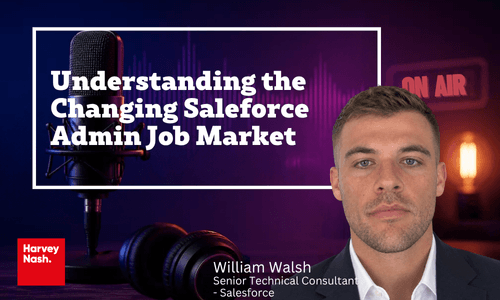
Understanding the Changing Salesforce Admin Job Market
Salesforce recently invited Harvey Nash’s very own William Walsh, Senior Technical Consultant - Salesforce, to join the Salesforce Admins Podcast for a conversation about the current Salesforce Admin job market. Hosted by Mike Gerholdt, the episode also features Maria Alvarez-Zarrilli, Founder and Principal Consultant at Throughline HR LLC. Together, they explore how the Salesforce Admin role is evolving and what today’s changing market means for professionals looking to build or grow their careers in the Salesforce ecosystem. The conversation looks at some of the questions currently shaping the Salesforce talent market, including what employers are looking for, how candidates can stand out, and how expectations around Salesforce roles are changing. William brings his perspective from working closely with both organizations and Salesforce professionals, while Maria adds her experience from the HR and career development side. The discussion touches on experience, skills, AI, communication, career paths, and what it takes to keep learning in a fast-changing technology landscape, but there’s much more to the conversation than we can cover here. Listen to the full Salesforce Admins Podcast episode to hear William and Maria’s perspectives firsthand and get a closer look at what’s happening across the Salesforce Admin job market. Whether you’re a Salesforce professional thinking about your next career move or an organization looking to understand the talent landscape, it’s a conversation worth tuning into.
In the News

AI and jobs: People will be at the heart of making AI work
This article was originally published on ComputerWeekly.com and is authored by Jason Pyle, Managing Director, Harvey Nash USA & Canada AI may be eliminating some job roles, but overall demand for human labour will increase amid signs of an 'AI boomerang'. It’s a subject that attracts endless debate: will AI replace whole swathes of human jobs and create an exodus from white collar professions? The trigger for me writing some reflections on this question is that no other than Jeff Bezos weighed in on the topic recently when speaking at a conference in Paris. His view was that far from decimating human roles, AI would unlock new opportunities and increase demand for human labour. I am in the Jeff Bezos camp. My belief is that just as other defining shifts like the creation of the internet created whole new classes of employment, so too will AI. That is not to say that it won’t redesign or remove some roles as the technology takes over certain tasks and processes itself – but it will also spawn new human activities. As an example of how things are changing, take software development. Increasingly, and as is already happening, AI will write new code itself. But skilled human engineers are still needed to manage the process, and oversee and check the results. Crucially, their human skills and experience will continue to be essential in making sure that the products being developed meet the needs of customers and support the strategic priorities of the business. That human understanding of the wider picture is something that AI may never be able to replace. An ‘AI boomerang’? As in any transformation, there will be something of a rebalancing. Interestingly, we are already seeing signs of this in the market – back in the favour of human skills. Talk is growing of an ‘AI boomerang’ amongst some organisations who cut back on existing staff or new hiring due to AI, but who are now beginning to push the balance back. There are several reasons for this. One is that it is still very early days in the AI revolution and organisations are still trying to find the appropriate model to set themselves up for it correctly. Another is that many businesses are still struggling to achieve real ROI from their AI investments – partly because it is early days – as our own research at Harvey Nash has shown: the 2025 Digital Leadership Report (DLR) found that only a third of businesses have achieved demonstrable ROI. A third element, related to this, is that AI is proving expensive. The newer AI models consume large numbers of tokens – the ‘burn’ is significant. These factors are all contributing to that boomerang effect. More broadly, the US technology recruitment market is holding up, with certain roles (AI engineers, data scientists, DevOps professionals, cybersecurity specialists) in high demand. AI will be additive There are other reasons to be optimistic from a human point of view. Our DLR also finds that the more an organisation invests in AI, the more likely they are to recruit technologists, rather than reduce the size of their workforce. In fact, we found that those organisations most ahead with large-scale implementations of AI are 24% more likely to be increasing their tech headcount than their peers, mostly in areas of AI and data. Other studies bear this out. For example, the Financial Times reported recently on research by Ramp across almost 22,000 companies in the US which found that firms making the largest AI investments grow employment by roughly 10% following adoption, while low-intensity adopters see no statistically significant change. Entry-level headcount rises 12% for high-intensity adopters too. This fuels my belief that AI will overall prove additive rather than taking away. It will create changes in how people work and what they do, but used effectively it will be an augmenter. The task in front of organisations is to get the balance right. It will be rather like seasoning a dish: you don’t want to go too heavily with any one ingredient but rather bring out the flavours from the right combination. Upskilling is crucial However, there is another element that is key to getting this right: upskilling. Whether it’s the tech team or other staff, it is critically important that people are empowered and enabled to use AI tools effectively, getting the most out of their capabilities and also managing the outputs appropriately. But this is an area where many businesses have more to do. The Harvey Nash Tech Talent & Salary Report found that while the majority of technologists (76%) have access to AI tools, far fewer feel they are being given structured support, time or clear frameworks to build capability (36%). Less than half (43%) are being given dedicated time to experiment and learn. A significant proportion report being expected to self‑learn (20%), while others are still waiting for formal training to be introduced (23%). I would urge organisations to step up their efforts in this area. Equipping people for AI is the real battleground in front of us. Investing in learning & development programmes, giving staff time to experiment and learn, and unlocking knowledge transfer via external parties the business works with, such as consultancies – all of these will contribute to the goal. It is worth exploring governmental support too. For example, in the US, the Department of Commerce’s Economic Development Administration (EDA) has launched a new initiative to put $25 million towards the AI Upskill Accelerator, a national grant competition to fund industry-led sectoral workforce partnerships that help upskill and reskill workers around AI technologies. Similarly, in the UK, the government is tackling the national AI skills gap through the AI Skills Boost, which aims to upskill 10 million workers by 2030. Led by DSIT and Skills England, the strategy combines free online training with major tech firms and reforms to technical education. Opportunity ahead The impact of AI on human jobs is still unfolding, and it will be a nuanced picture. However, I take a positive view. There seems little doubt that the organisations who harness AI effectively will be the winners of the future, launching value-adding new products and services, finding ways to do things smarter, boosting productivity. This brings enormous opportunity – and people will be at the heart of making it happen.
Blog

What is Tech Recruitment and Why Does a Specialist Recruiter Make the Difference?
Technology is driving transformation across every industry, from retail and healthcare to financial services and manufacturing. But while organizations continue to invest in new systems, AI, cloud platforms, and data capabilities, many face a challenge in finding the right people to deliver them. That's where tech recruitment comes in. Unlike general recruitment, tech recruitment requires a deep understanding of technology, the talent market, and the skills businesses need to achieve their goals. Whether you're hiring a software engineer, ERP consultant, data analyst, or technology leader, working with a specialist recruiter can make the difference between simply filling a vacancy and building a team that drives long-term success. What Is Tech Recruitment? Tech recruitment is the process of sourcing, assessing, and hiring professionals for technology-focused roles. While that may sound straightforward, today's technology landscape is anything but. Organizations now rely on specialists across software engineering, cloud, cybersecurity, data and analytics, enterprise applications, AI and digital leadership. Each area requires different technical expertise, making it increasingly difficult for businesses to hire effectively without specialist knowledge. A tech recruiter understands more than job titles and technical skills. They understand how different roles contribute to wider business objectives, whether that's modernizing legacy systems, improving customer experiences, or delivering digital transformation. They also stay close to market trends, helping employers understand which skills are in demand and how to attract the talent they need. What Does a Tech Recruiter Actually Do? The role of a specialist tech recruiter extends far beyond matching resumes to job descriptions. Experienced recruiters spend time building relationships with technology professionals, many of whom aren't actively looking for a new role. This gives employers access to a much wider talent pool than they would reach through job boards alone. They also advise businesses throughout the hiring process, helping to shape job requirements, benchmark salaries, and navigate an increasingly competitive market. Because they understand both the technology and the hiring landscape, they can identify candidates with not only the right technical skills but also the commercial awareness and cultural fit needed to succeed. For organizations hiring for specialist or business-critical positions, that expertise can save significant time while improving the quality of every hire. Why Choose Harvey Nash as Your Tech Recruitment Partner? We offer a wide range of talent solutions and understand that successful technology hiring isn't just about finding people with the right technical skills. It's about understanding the wider business challenge. A strong example of this is our long-term partnership with a regional grocery retailer. As our client invested in modernizing the technology that supports their stores, from ERP and SAP to finance systems, data analytics, merchandising platforms, and point-of-sale technology, it needed highly skilled professionals across multiple disciplines while ensuring day-to-day operations continued without disruption. Over the past seven years, Harvey Nash has placed nearly 50 permanent and contract technology professionals, supporting modernization across several business functions. These hires have strengthened financial systems, improved data visibility, enhanced enterprise applications, and helped deliver the technology that underpins everyday store operations. Rather than supporting a single project, we have become a trusted extension of our client's internal hiring team. Today, the partnership continues with multiple active searches, demonstrating the value of working with a recruitment partner that understands both the technical requirements of individual roles and the long-term goals of the business. The Challenges of Hiring Tech Talent in the US Competition for technology talent remains high across the US. Our 2026 Tech Talent & Salary Report highlights that employers continue to face persistent skills shortages across areas including AI, cybersecurity, software engineering, cloud and platform technologies, making specialist hiring expertise more valuable than ever. At the same time, candidates have more choice than ever before. Remote work has expanded opportunities nationwide, meaning employers are often competing for talent beyond their local market. Finding candidates with the right technical expertise is only part of the challenge. Many organizations also need professionals who can communicate with stakeholders, understand business priorities, and contribute to transformation initiatives from day one. Working with a specialist recruiter provides access to market insight, established talent networks, and candidates who may never actively apply for a role, helping businesses hire with greater confidence. The Tech Roles We Recruit For Technology teams are made up of specialists with a wide range of expertise. We support hiring across our technology specialisms, including software engineering, cloud, cybersecurity, AI, data and analytics, project and change management, DevOps and technology leadership. Whether clients need a single specialist or an entire transformation team, our recruiters understand the skills, experience, and market dynamics required to identify the right people. Frequently Asked Questions About Tech Recruitment What makes a tech recruiter different from a general recruiter? A specialist tech recruiter understands technology roles, market trends, salary expectations, and the skills required for specialist positions, enabling them to identify stronger candidates and provide strategic hiring advice. Can tech recruiters support both permanent and contract hiring? Yes. Many organizations require a combination of permanent employees and contract professionals, particularly during large transformation or implementation projects. Is specialist tech recruitment only for large organizations? No. Businesses of all sizes can benefit from specialist market knowledge and access to highly skilled technology professionals, whether they're hiring one critical role or building an entire team. Build a Stronger Technology Team Technology projects succeed because of the people behind them. Finding the right talent isn't just about filling open roles. It's about building teams with the skills, experience, and adaptability to drive innovation, support transformation, and deliver long-term business value. If you're ready to strengthen your technology team, explore our Talent Solutions or submit an opening to discuss your hiring needs with one of our technology recruitment specialists.