


Looking to make your next hire? Speak with one of our Talent experts today.

Technology Recruitment Specialisms
Discover our technology recruitment specialisms and how our deep market expertise helps you secure exceptional tech talent. Ready to talk about your hiring needs? Click below to get started.
How we support your hiring goals
Struggling to find specialist tech talent?
We continually invest in building and nurturing an extensive network of highly skilled technology professionals. By keeping candidates engaged and ready to move, we ensure you gain both the technical expertise and cultural fit needed, so innovation and delivery never stall.
Finding the right talent quickly proving difficult?
We deliver specialist technology talent at speed. Using data-driven insights, deep market knowledge, established networks, and proven recruitment expertise, we identify and onboard the right people fast, helping you hit critical project milestones.
Need deeper tech talent insight and market expertise?
We go beyond traditional recruitment. With more than 35 years of experience, our specialist teams combine industry knowledge across IT and technology disciplines with real-time market intelligence. We don’t just source talent, we advise you where to find it and how to attract it.
Is your time-to-hire too long, driving up costs and slowing progress?
We streamline recruitment to save time and reduce cost per hire. By uncovering hard-to-reach tech talent efficiently, we accelerate hiring timelines, minimize downtime, and keep your business competitive.
Our specialisms
What sets us apart
A recruitment partner you can trust
Trust underpins everything we do, from client relationships to candidate engagement. We focus on making meaningful connections, going the extra mile to match people with roles where they thrive. Our consistently high Net Promoter Scores reflect the human approach that differentiates us. It’s not just what we do, it’s how we do it.
Built on long standing partnerships
We take time to understand your business challenges and deliver recruitment solutions that truly fit. For more than 35 years, we’ve earned trust by exceeding expectations for both clients and candidates. Over one-third of our customers have partnered with us for more than a decade.
Unrivalled candidate networks
We continually invest in building long-term candidate relationships grounded in trust and understanding. This means we know our talent, their skills, motivations, and aspirations, enabling confident, well-informed matches that benefit both clients and candidates.
Delivering talent at pace
In a fast-moving technology landscape, speed matters. Our talent experts combine data-driven insights, innovative sourcing strategies, and targeted search to quickly identify and engage high-quality candidates, keeping your projects moving and teams ahead.
Dedicated technology recruitment specialists
With 35+ years of specialist technology recruitment experience, we offer deep sector knowledge, powerful networks, and a global successful track record. We’ve partnered with two-thirds of the world’s leading companies, placing experts across roles from software engineers and data scientists to CIOs and CDOs.

News & Insights
Blog

What are AI staffing solutions? A guide to hiring machine learning & AI talent
Artificial intelligence is changing how businesses operate, from automating everyday processes to improving decision-making and creating new opportunities for innovation. But as organizations move from experimenting with AI to implementing it across their operations, finding the right talent is becoming an increasingly important challenge. Hiring AI professionals requires more than identifying candidates with technical qualifications. Businesses need people who can develop, implement, and manage AI technologies while understanding how these solutions support wider business objectives. This is where AI staffing solutions can make a difference. By combining specialist recruitment expertise with knowledge of emerging technologies and talent markets, organizations can identify the skills they need and build teams capable of delivering meaningful results. But what exactly do AI staffing solutions involve, and how can specialist machine learning and AI recruitment support your hiring strategy? What are AI staffing solutions? AI staffing solutions are specialized recruitment services designed to help organizations find, assess, and hire professionals with expertise in artificial intelligence and machine learning. AI staffing requires an understanding of specific technologies, their applications, and the experience needed to deliver successful AI initiatives. These solutions support businesses hiring for roles including: Machine Learning Engineers: Developing, training, and deploying machine learning models. Data Scientists: Analyzing complex datasets and building predictive models to support decision-making. AI Architects: Designing the systems and infrastructure needed to integrate AI into business operations. Natural Language Processing (NLP) Specialists: Developing technologies that enable machines to understand and generate human language. MLOps Engineers: Managing the infrastructure, deployment, monitoring, and ongoing performance of machine learning models. However, AI expertise is no longer limited to dedicated AI positions. Software engineers, cloud specialists, data engineers, and product managers are increasingly expected to understand how AI technologies fit into their work. As a result, organizations need to consider both specialist AI hires and the AI-related capabilities required across their wider technology teams. How Harvey Nash delivers machine learning & AI recruitment Successful machine learning recruitment starts with understanding what a business is trying to achieve. An organization developing its first AI strategy will have different talent requirements, from scaling an established machine learning platform to integrating AI into existing products. At Harvey Nash, our dedicated AI and machine learning recruitment specialists work with organizations to understand their objectives, technical environment, and hiring challenges before identifying the talent needed to move forward. Our approach supports businesses at different stages of their AI journey. Building AI strategy and leadership Establishing a successful AI function often begins with the right leadership. Organizations may need Heads of Data Science, AI Policy Advisors, AI Architects, or senior technology leaders who can define priorities and translate technical opportunities into business outcomes. Through our executive search services, we help businesses identify leaders with the technical understanding, strategic perspective, and experience needed to guide AI initiatives. Supporting implementation and delivery Turning an AI strategy into a working solution requires expertise across machine learning engineering, data infrastructure, development, deployment, and ongoing optimization. Our recruitment specialists connect businesses with professionals who can support these activities, whether they are building a new team or expanding an existing one. Because AI initiatives often depend on several technology functions working together, we also recruit across a wider range of technology specialisms, including cloud, cybersecurity, data, DevOps, and software engineering. Flexible hiring solutions Not every AI project requires the same hiring model. Some organizations need permanent employees to establish long-term capabilities. Others require contract professionals for specific implementations, interim specialists to address immediate skills gaps, or project-based delivery through a Statement of Work (SoW). Our direct hiring and contract staffing services, alongside our broader talent solutions, give businesses flexibility to build teams around their requirements. Key Benefits of Partnering With an AI Staffing Specialist Finding professionals with the right combination of AI expertise, industry knowledge, and business understanding can be challenging. Working with a specialist recruitment partner offers several advantages. Faster access to specialist talent Recruiting for niche technical positions can involve lengthy searches, particularly when the required skills are highly specific. Specialist recruiters understand the AI talent landscape and can identify candidates with relevant experience more efficiently, helping businesses reduce recruitment delays. By drawing on our established talent network, our recruitment specialists produced a shortlist of six qualified candidates in under two weeks. Five progressed to interview, leading to a successful appointment within the client's required timeframe. Access to candidates beyond traditional job boards Many experienced AI professionals are not actively searching for new opportunities. Established relationships with specialist talent communities allow recruiters to engage professionals who may otherwise be difficult to reach through conventional advertising. This gives businesses access to a broader pool of candidates with relevant technical experience. Reduced risk when hiring niche roles Hiring the wrong specialist can delay projects, increase costs, and affect the delivery of critical technology initiatives. Specialist AI recruiters can help employers clarify technical requirements, assess relevant experience, and identify candidates who bring both technical expertise and an understanding of business priorities. Better hiring decisions through market intelligence Understanding candidate availability, salary expectations, and emerging skills requirements is essential when planning an AI recruitment strategy. Harvey Nash's Tech Talent & Salary Report and Digital Leadership Report provide insights into technology hiring trends, workforce challenges, and the priorities shaping digital leadership. Combined with our recruitment expertise, these insights help organizations make more informed hiring and workforce planning decisions. You can explore examples of our wider recruitment partnerships and client outcomes through our success stories. AI Staffing Solutions vs. Traditional Tech Recruitment Traditional technology recruitment focuses on identifying professionals with the skills and experience needed for established IT roles, such as software development, infrastructure, and technical support. While these capabilities remain essential, AI and machine learning recruitment introduces additional considerations. For example, two candidates may both have experience developing machine learning models, but their expertise could be very different. One might specialize in research and model development, while another has extensive experience deploying models into production environments using MLOps practices. Similarly, experience with large language models (LLMs) does not automatically mean a candidate has the skills to build reliable enterprise AI applications. Depending on the role, employers may also need expertise in retrieval-augmented generation, vector databases, model evaluation, or AI infrastructure. The distinction goes beyond technical knowledge. Organizations increasingly need AI professionals who understand data privacy, model governance, responsible AI practices, and the commercial objectives behind AI investment. A specialist AI recruitment partner helps businesses distinguish between these requirements, ensuring hiring decisions are based on the capabilities needed to deliver a particular outcome rather than broad familiarity with AI technologies. Is It Time to Bring in an AI & ML Recruitment Partner? As AI adoption develops, businesses may find that existing recruitment approaches are no longer sufficient to meet their requirements. There are several signs that specialist support could be valuable: Persistent skills gaps: Your organization is struggling to find professionals with specific AI experience. AI projects are becoming harder to scale: You have moved beyond initial experimentation but lack the technical resources to support wider implementation. Critical leadership positions remain unfilled: You need experienced AI or data leaders to define strategy and guide investment. Hiring requirements are changing: Your organization needs a combination of permanent talent, contract expertise, and project-based support. The right recruitment approach will depend on your organization's current capabilities, project priorities, and longer-term ambitions. Working with a specialist partner can help you identify which skills are essential, where the talent is available, and how best to structure your hiring strategy. Build Your AI Team With Harvey Nash Whether you're hiring your first Machine Learning Engineer, expanding an AI development team, or searching for experienced technology leadership, having the right people in place is essential to turning AI investment into business results. At Harvey Nash, our dedicated Machine Learning & AI recruitment specialists combine technical recruitment expertise, established talent networks, and market intelligence to help businesses secure the professionals they need. Looking to strengthen your AI capabilities? Submit your hiring requirements and speak with our team about finding the right AI talent for your organization.
Blog

What is RPO? A guide to recruitment process outsourcing
Hiring demand can change quickly, but most internal talent acquisition teams cannot add capacity overnight. Recruitment process outsourcing (RPO) gives organizations a flexible way to strengthen all or part of their hiring function while keeping the process aligned with their business, employer brand, and workforce goals. That flexibility matters in a market where skills remain difficult to secure. Our 2026 Tech Talent & Salary Report found that 52% of respondents viewed a lack of people as a huge or significant barrier to achieving technology goals, while 42% expected their team to grow during the next year. For organizations facing sustained demand, specialist hiring needs, or pressure on internal resources, RPO can provide the structure and recruiting capacity required to keep growth plans moving. What is Recruitment Process Outsourcing (RPO) Recruitment process outsourcing (RPO) is a model in which an organization transfers responsibility for some or all of its recruitment process to an external specialist. The provider works as an extension of the internal team, following the organization's hiring standards and representing its employer brand in the market. The scope can be tailored to the business. An RPO partner may support a specific project, region, business unit, or hiring surge. It can also manage the full recruitment cycle, including workforce planning, sourcing, screening, interview coordination, offer management, onboarding support, technology, and reporting. This makes RPO different from simply sending individual vacancies to a recruitment agency. RPO is one option within a broader set of talent solutions. The right model depends on whether a business needs support with permanent hiring, contract labour, individual specialist roles, or an integrated workforce strategy. How Harvey Nash delivers RPO recruitment Harvey Nash delivers RPO through an embedded model built around the client's hiring priorities, processes, culture, and technology. Our team works as an extension of the internal talent acquisition function, creating a recruitment service that feels connected to the business rather than separate from it. Depending on the scope, the team can manage candidate sourcing and screening, schedule interviews, support offers, coordinate onboarding, and provide data throughout the recruitment process. Multi-channel talent attraction and our technology networks help expand access to qualified candidates, including people with hard-to-find skills. The service also uses labor market insight, talent intelligence, and recruitment data to help hiring leaders make informed decisions. Consistent reporting shows where candidates are coming from, where delays occur, and how hiring performance changes over time. Employer branding, candidate communication, and inclusive recruitment practices are built into the process so that growth does not come at the expense of candidate experience. For Tomasz Wojtowicz, Senior Technical Recruiter, who worked closely with the client, the real value of an embedded RPO partnership comes from combining recruitment expertise with a deep understanding of the organisation. “An embedded RPO model delivers the most value when the recruiter truly understands the client’s business, from its culture and values to how teams work and where the organisation is heading. That understanding helps turn hiring priorities into more focused searches, stronger shortlists and better-informed decisions. It also gives hiring managers a recruitment partner who can adapt as priorities change, bring specialist market knowledge and represent the employer brand consistently. Ultimately, it gives organisations the expertise and capacity to scale recruitment while keeping hiring closely aligned with their wider business goals.” You can explore our client success stories to see how Harvey Nash applies tailored talent solutions to different workforce challenges Key benefits of RPO for growing organizations Scalable recruiting capacity: An RPO team can expand or reduce support as hiring demand changes, helping the business respond without permanently increasing the size of its internal recruitment function. Access to specialist talent: Dedicated recruiters bring market knowledge, sourcing networks, and experience in the skills the organization needs. This can be particularly valuable in areas such as AI, cybersecurity, data, cloud, and software engineering. A faster and more consistent process: Clear workflows, defined responsibilities, and dedicated delivery capacity can reduce delays while giving every candidate and hiring manager a more consistent experience. Better cost visibility: Centralized processes and reporting help leaders understand recruitment spend, reduce duplication, and identify where time or budget is being lost. Useful hiring data: RPO reporting can reveal bottlenecks, source effectiveness, time-to-fill trends, and shifts in talent availability, giving leaders evidence for future workforce decisions. Interest in flexible resourcing models continues to rise. In our 2025 Digital Leadership Report, 42% of digital leaders expected outsourcing to increase during the following 12 months. For many organizations, RPO offers a practical way to add hiring capability while keeping the operating model flexible. RPO and Traditional Recruitment Compared Traditional recruitment is often vacancy-led. An agency is asked to fill an individual role, submits candidates, and is paid when a hire is made. This remains a useful option when an organization needs targeted support for a small number of permanent or contract positions. Harvey Nash provides direct hire and contract staffing for this type of requirement. Traditional recruitment Recruitment process outsourcing Usually focused on individual vacancies Covers an agreed part or all of the hiring process Often works alongside existing internal processes Operates as an embedded extension of the internal team Best suited to targeted or occasional hiring Designed for repeat, project-based, or high-volume demand Reporting is commonly vacancy-specific Program-level data supports workforce planning and improvement RPO should also be distinguished from a managed service provider program, which typically manages a contingent workforce and its staffing suppliers. Organisations with significant temporary labour needs may be better suited to an MSP and VMS partnership, while those looking to improve permanent talent acquisition at scale may gain more from RPO. Some businesses use both as part of a wider workforce strategy. Is RPO right for your business RPO is worth considering when hiring demand is consistent, increasing, or difficult to predict, and can be a suitable option for all sizes of organizations. It can also help when internal recruiters are stretched, specialist roles remain open too long, candidate experience varies across teams, or leaders lack reliable recruitment data. Before choosing a model, define the business outcome you need. That may be faster hiring, access to scarce skills, support for a new location, a stronger employer brand, lower process costs, or better visibility across recruitment. A clear goal makes it easier to decide what the provider should own, how the internal team will work with it, and which measures will define success. Build a more scalable hiring function The right RPO partnership gives your organisation added capability without losing control of its brand or hiring priorities. Learn more about Harvey Nash recruitment process outsourcing or contact our team to discuss the hiring challenges, skills, and scale your business needs to address.
Events

What Happens When AI Actually Works? Lessons From Ai4 2026
The conversation around artificial intelligence is changing. At this year’s Ai4 conference in Las Vegas, more than 12,000 attendees gathered to discuss the technologies, strategies and challenges shaping the next stage of AI adoption. For Harvey Nash Tech Evangelist David Savage, the most interesting conversations were not necessarily about getting AI into the enterprise. They were about what comes next. From August 4–6, David moderated a panel exploring the growing role of AI coding assistants and how AI agents could augment software development. He also recorded conversations with digital and technology leaders for Harvey Nash’s Tech Talks podcast. Across those discussions, one theme kept resurfacing: organizations are spending significant time figuring out how to deploy AI, but far less time defining what success looks like once deployment is complete. Here are David’s key takeaways from Ai4 2026. An AI-savvy audience still had plenty of questions Walking into a conference session, you never quite know who will be in the room. During the panel on AI coding assistants, David asked the audience how many people were software engineers. Roughly 95% raised their hands. That was revealing. The session attracted an audience with substantial technical experience, yet the discussion showed that even people who are deeply engaged with AI are still working through fundamental questions about how these technologies should be used. Research and conversations featured on Tech Talks have frequently highlighted a similar dynamic: engineers can sometimes feel more comfortable using AI in their day-to-day work than their leaders do. But technical familiarity does not eliminate uncertainty. Even experienced professionals are looking for practical guidance, reassurance and opportunities to learn from their peers. Being further along in the AI journey does not mean having all the answers. One audience question captured that uncertainty particularly well. A teacher took the microphone and asked: “What should I be teaching my kids?” It was a simple question, but it shifted the conversation away from models, coding assistants and agents and toward something much bigger: the people who will live with the consequences of today's technology decisions. AI may transform how work gets done, but human judgment, creativity and accountability remain critical. Organizations that reduce roles based purely on expectations of AI-driven productivity may also find that they still need people to provide oversight, make decisions and take responsibility for outcomes. For the next generation, developing the skills and confidence to work alongside increasingly capable AI systems will be just as important as understanding the technology itself. The real question starts after deployment At the end of every Tech Talks interview, David asks guests the same question: “What aren’t we talking about?” It is designed to move the conversation beyond the subjects dominating the technology industry and uncover issues that may not yet be receiving enough attention. At Ai4, one potential blind spot became particularly clear. There was extensive discussion about deploying AI at scale. There was considerably less discussion about what organizations should expect once that deployment succeeds. Erin Boyd, Chief Digital Strategy and AI Officer at The AES Corporation, summed up the concern: “I do personally think we are not focusing enough on what happens when we actually successfully deploy agentic AI.” Organizations are investing heavily in selecting models, building agent frameworks and creating guardrails. Those are important steps, but they are means to an end. The bigger questions are organizational. What happens when agentic AI becomes embedded in day-to-day operations? How might responsibilities shift? Will teams become smaller or simply change shape? How should decision-making evolve when AI agents are handling increasingly important tasks? And who remains accountable for the final outcome? Those questions should be part of the strategy before AI is deployed at scale, rather than being addressed after the technology is already embedded in the business. Start with the outcome, then choose the technology Another recurring theme at Ai4 was the importance of connecting AI investments to measurable business outcomes. Stephen Henn, Managing Director of AI Innovation at DLA Piper, described the difference between starting with technology and starting with the problem the business actually needs to solve. “What do I want to get out of it? What is the big impact? We know that if we solve this problem, we’re going to get ROI. Then work backwards.” That approach puts the business objective ahead of the technology. Instead of asking where a new model or AI agent could be deployed, organizations can start by identifying a specific business challenge, defining the desired result and determining how success will be measured. Technology can then be evaluated against that outcome. This may sound straightforward, but it represents an important shift in how organizations approach AI. A technically successful deployment is not necessarily a successful business implementation. AI can be integrated into a process, perform exactly as designed and still fail to deliver meaningful value if the original objective was unclear. The technology should support the outcome not become the outcome. AI investment needs a financial perspective AI conversations also need to extend beyond technology and operations. Arjun Srinivasan, SVP of AI and Data Science at ShipStation Global, highlighted the importance of bringing financial leadership into the discussion: “I would love to hear more from a CFO’s perspective. They’re the ones who sign the cheque. They’re the ones who are answerable to the board. I’m not hearing that.” As AI programs move beyond experimentation and require larger, longer-term investments, CFOs and other financial leaders have an increasingly important role to play. They need visibility into what organizations are trying to achieve, how investments will be evaluated and what business results are expected in return. AI strategy therefore cannot sit exclusively within the technology function. The people responsible for approving investment and ultimately explaining that investment to the board need to be part of the conversation from the beginning. Moving from AI adoption to AI outcomes Ai4 provided a useful snapshot of where organizations are today. Many are still working through the fundamentals: selecting models, establishing governance, building guardrails, developing use cases and determining how AI can be introduced responsibly at scale. Those conversations matter. But the next stage of AI maturity will require a different set of questions. If an organization successfully deploys AI across critical workflows, what changes? What happens to teams and roles? How does decision-making evolve? How is accountability maintained? How will leaders know whether the investment is actually delivering the expected business impact? These questions are particularly important as organizations move from experimentation into broader implementation. The AI conversation has largely focused on capability what these systems can do and how quickly they can be deployed. The next phase needs to focus equally on organizational impact and business value. Ultimately, the challenge may not be figuring out how to deploy AI. It may be defining what the organization wants to become once AI is successfully deployed. Hear more perspectives from Ai4 as David’s conversations with digital leaders are released on the Tech Talks podcast. Want to be a guest kindly reach out to David Savage or Harvey Nash. Watch the video below for more of David’s conversations with technology and digital leaders at Ai4.
In the News
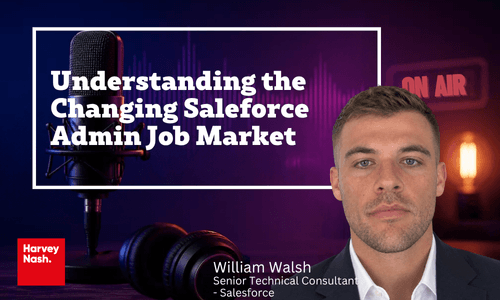
Understanding the Changing Salesforce Admin Job Market
Salesforce recently invited Harvey Nash’s very own William Walsh, Senior Technical Consultant - Salesforce, to join the Salesforce Admins Podcast for a conversation about the current Salesforce Admin job market. Hosted by Mike Gerholdt, the episode also features Maria Alvarez-Zarrilli, Founder and Principal Consultant at Throughline HR LLC. Together, they explore how the Salesforce Admin role is evolving and what today’s changing market means for professionals looking to build or grow their careers in the Salesforce ecosystem. The conversation looks at some of the questions currently shaping the Salesforce talent market, including what employers are looking for, how candidates can stand out, and how expectations around Salesforce roles are changing. William brings his perspective from working closely with both organizations and Salesforce professionals, while Maria adds her experience from the HR and career development side. The discussion touches on experience, skills, AI, communication, career paths, and what it takes to keep learning in a fast-changing technology landscape, but there’s much more to the conversation than we can cover here. Listen to the full Salesforce Admins Podcast episode to hear William and Maria’s perspectives firsthand and get a closer look at what’s happening across the Salesforce Admin job market. Whether you’re a Salesforce professional thinking about your next career move or an organization looking to understand the talent landscape, it’s a conversation worth tuning into.